How Broken Links Hurt Your AI Search Visibility in 2026
AI search has created a second visibility layer on top of traditional search. A page can rank in Google's results yet never appear as a supporting link in an AI Overview. It can be retrieved by an answer engine but lose the citation to another source. It can even earn a citation that later becomes useless because the cited URL starts returning a 404.
Broken links matter at several points in that pipeline. However, the evidence is more nuanced than many generative engine optimization (GEO) guides suggest. There is strong evidence that pages need to be crawlable, indexable, relevant, and accessible to appear in AI search. There is no public evidence that one broken outbound citation triggers a hidden "AI credibility penalty."
This updated guide separates those two ideas. It explains the link failures that definitely prevent discovery or waste traffic, the indirect effects that are reasonable but not yet proven as ranking signals, and the results of our August 2026 audit of AI crawler access across 30 prominent websites.
What Is Generative Engine Optimization (GEO)?
Generative Engine Optimization is the practice of improving how content is discovered, selected, cited, and used by AI-powered search systems such as ChatGPT Search, Google AI Overviews and AI Mode, Perplexity, Claude, and Microsoft Copilot.
The term was established by the original GEO research paper, presented at ACM SIGKDD 2024. Its experiments found that some content modifications increased source visibility by up to 40% in the tested environment. Citations, quotations, and statistics were among the effective modifications.
That result is important, but it is often overstated. The experiments modified documents that were already present in a fixed context. They did not prove that adding citations makes an unknown page organically discoverable across live search engines. A 2026 critical review of 45 GEO studies found that no reviewed technique had yet demonstrated a stable, longitudinal, cross-platform effect on organic discoverability and downstream traffic.
The practical conclusion is not that GEO is meaningless. It is that GEO starts with search fundamentals and then adds a citation layer. Google now says this directly: its generative search features use the existing Search index and quality systems, with no additional technical requirements beyond normal Search eligibility.
The AI Citation Pipeline
It helps to stop thinking of AI visibility as one ranking and instead see it as a sequence:
- Crawl: Can the relevant crawler request the page?
- Index: Is the page eligible and stored in a search index?
- Retrieve: Does the page match one of the engine's searches or query fan-outs?
- Cite: Is the page selected as a visible supporting source?
- Absorb: Does information from the page materially shape the generated answer?
- Click: Does a user follow the citation, and does the destination still work?
Recent research supports these distinctions. A 2026 study of 21,143 valid citations across ChatGPT, Google, and Perplexity found that citation breadth and answer-level influence diverge. Perplexity and Google cited more sources on average in that dataset, while ChatGPT used fewer sources but drew more heavily from the pages it did use.
Broken links do not affect every stage in the same way:
| Link problem | Pipeline stage | What definitely happens |
|---|---|---|
| Important page is only reachable through a broken internal link | Crawl and index | Users and crawlers lose a discovery path |
| External backlink points to a deleted URL on your site | Crawl, authority, and click | The link sends visitors and crawlers to a 404 until you restore or redirect it |
| AI answer cites a URL that later breaks | Click | The visible citation becomes a dead end |
| Article cites a dead external source | Verification | Readers cannot check the claim; a direct AI ranking penalty has not been publicly demonstrated |
| Redirect chain ends on the wrong page | Index and click | Crawlers may consolidate signals to an unintended canonical, and users land on the wrong destination |
This is why link health belongs in an AI visibility program, even without inventing a secret broken-link score.
Our 30-Site AI Crawler Audit
To see how real websites handle AI crawlers, we audited 30 prominent domains on August 12, 2026. The sample contained:
- 10 SEO websites: Ahrefs, Semrush, Moz, Search Engine Land, Search Engine Journal, Yoast, Backlinko, Screaming Frog, Onely, and SearchPilot
- 10 SaaS websites: HubSpot, Shopify, Webflow, Wix, Zapier, Notion, Canva, Stripe, Cloudflare, and Mailchimp
- 10 publishers and reference platforms: Wikipedia, The New York Times, BBC, The Guardian, Reuters, TechCrunch, Wired, Ars Technica, Stack Overflow, and GitHub
This was a focused observational sample, not a random census of the web. We fetched each site's root robots.txt, evaluated access to / for seven crawler tokens, and requested the homepage with browser, OAI-SearchBot, PerplexityBot, and Claude-SearchBot user-agent strings.
What robots.txt allowed
| Crawler token | Purpose | Allowed | Blocked | Indeterminate |
|---|---|---|---|---|
| Googlebot | Google Search, including AI features | 29 | 0 | 1 |
| OAI-SearchBot | ChatGPT Search | 27 | 2 | 1 |
| Claude-SearchBot | Claude search indexing | 24 | 5 | 1 |
| PerplexityBot | Perplexity search | 23 | 6 | 1 |
| GPTBot | OpenAI model training | 23 | 6 | 1 |
| Google-Extended | Gemini training and some non-Search grounding | 23 | 6 | 1 |
| ClaudeBot | Anthropic model training | 20 | 9 | 1 |
The indeterminate domain was Stack Overflow. Its robots.txt endpoint returned HTTP 418 with a body that declared search=no, ai-train=no and Disallow: /. Because crawler behavior for a non-200 robots response can vary, we did not count it as a normal allow or block.
The clearest split was by business model:
- All 20 SEO and SaaS sites allowed OAI-SearchBot, PerplexityBot, Claude-SearchBot, and Googlebot at the root.
- Two of those 20 sites — Onely and Canva — separated search visibility from training by blocking GPTBot and ClaudeBot while leaving dedicated search crawlers accessible.
- Publishers were more restrictive. Only three of the ten publisher/reference domains clearly allowed PerplexityBot at the root, while seven allowed OAI-SearchBot.
- None of the 29 sites with a conventionally readable robots file blocked Googlebot from the homepage.
This does not prove that allowing a crawler produces citations. It shows that organizations actively distinguish traditional search, AI search, and model training instead of treating every AI bot as the same thing.
What the homepage requests returned
| Request profile | HTTP 200 | HTTP 4xx |
|---|---|---|
| Browser user agent | 27 | 3 |
| OAI-SearchBot user agent | 26 | 4 |
| PerplexityBot user agent | 25 | 5 |
| Claude-SearchBot user agent | 25 | 5 |
Most sites returned the same response to browser and AI-search user agents. The notable differences were:
- The New York Times returned a normal homepage to the browser profile but HTTP 403 to all three AI-search profiles.
- The Guardian returned its homepage to the browser and OAI-SearchBot profiles but HTTP 403 to the PerplexityBot and Claude-SearchBot profiles.
- Stack Overflow returned HTTP 403 to the browser and OAI profiles and HTTP 402 to the Perplexity and Claude profiles from our test environment.
These probes have an important limitation: they originated from one VPS IP address and used declared user-agent strings. They did not originate from each provider's official crawler IP range. A WAF can evaluate IP reputation, geography, TLS fingerprints, cookies, and request history in addition to the user agent. Therefore, these results identify response differences worth investigating; they do not prove that an official bot receives the same response.
Perplexity's own documentation recommends combining user-agent checks with its published crawler IP ranges when configuring a WAF. OpenAI similarly tells publishers to allow OAI-SearchBot through both hosting and CDN controls, not just robots.txt.
Search Crawlers and Training Crawlers Are Different
The most useful finding from the audit is also the easiest configuration mistake to avoid: blocking model training does not always require blocking AI search.
| Provider | Search or user-facing crawler | Training control | Important distinction |
|---|---|---|---|
| OpenAI | OAI-SearchBot | GPTBot | OpenAI says OAI-SearchBot access is important for inclusion in ChatGPT Search; GPTBot controls potential training use |
| Anthropic | Claude-SearchBot, Claude-User | ClaudeBot | Blocking Claude-SearchBot can reduce search visibility; blocking ClaudeBot signals exclusion from future training datasets |
| Perplexity | PerplexityBot, Perplexity-User | No foundation-model training role for these two bots | Perplexity says PerplexityBot is for search and not foundation-model training |
Googlebot | Google-Extended | Googlebot controls Search eligibility, including AI Overviews and AI Mode; Google-Extended does not control Google Search ranking or inclusion |
The provider documentation is explicit on this point: OpenAI's publisher guidance, Anthropic's crawler documentation, and Perplexity's crawler reference all assign different purposes to different bot identities.
For Google, the distinction is especially easy to misunderstand. Blocking Google-Extended does not opt a site out of Google AI Overviews. AI features in Search are controlled through Googlebot access and normal Search preview controls such as noindex, nosnippet, data-nosnippet, and max-snippet.
Where Broken Links Affect AI Visibility
1. Broken internal links weaken discovery
Google's official AI-search guidance lists internal links as a way to make content findable. If a key guide is absent from navigation, orphaned, or linked through a URL that returns 404, both users and crawlers have fewer reliable paths to it.
This is not an AI-only issue. It is a search architecture issue that carries into AI features because those features depend on search indexes. Start by fixing internal links to important pages, then update the sitemap and canonical signals if the URL changed.
2. Broken cited URLs waste the citation
If an answer engine already cites your page and that page starts returning 404, the immediate loss is not theoretical. A user who follows the source reaches a dead end. The URL may eventually disappear from the underlying index or be replaced by another source.
When a cited page moves, use a direct 301 redirect to the closest equivalent destination. Avoid redirecting every deleted article to the homepage; that can create a soft 404 and gives the user none of the information promised by the citation.
3. Broken backlinks point authority and visitors at nothing
Backlinks to removed pages still exist on other websites, but their destination no longer works. Restoring the content or adding a relevant 301 redirect repairs the user journey and can preserve link signals used by traditional search systems. Our guide to finding and reclaiming broken backlinks covers the complete workflow.
Because AI search commonly builds on traditional indexes and rankings, recovering a useful, indexable destination is a defensible GEO action. Claiming that every AI engine independently assigns a special backlink score would go beyond the public evidence.
4. Dead outbound sources damage verifiability
An outbound reference exists so a reader can verify a claim or continue researching it. When that reference breaks, the article delivers less value. This matters most for research summaries, statistics, legal guidance, product comparisons, and any page whose credibility depends on its evidence.
What we can say confidently:
- The source is no longer verifiable at the linked location.
- Users encounter a failed journey.
- The article may contain an outdated claim if its evidence has disappeared or changed.
- Maintaining citations is part of maintaining accurate content.
What we cannot currently prove from public research is that a live AI search engine detects one broken outbound URL and applies a direct ranking demotion to the page containing it. That is a plausible hypothesis, not an established signal.
The scale of the maintenance problem is still substantial. Pew Research found that 54% of Wikipedia pages contained at least one broken reference link in its spring 2023 snapshot, published in 2024.
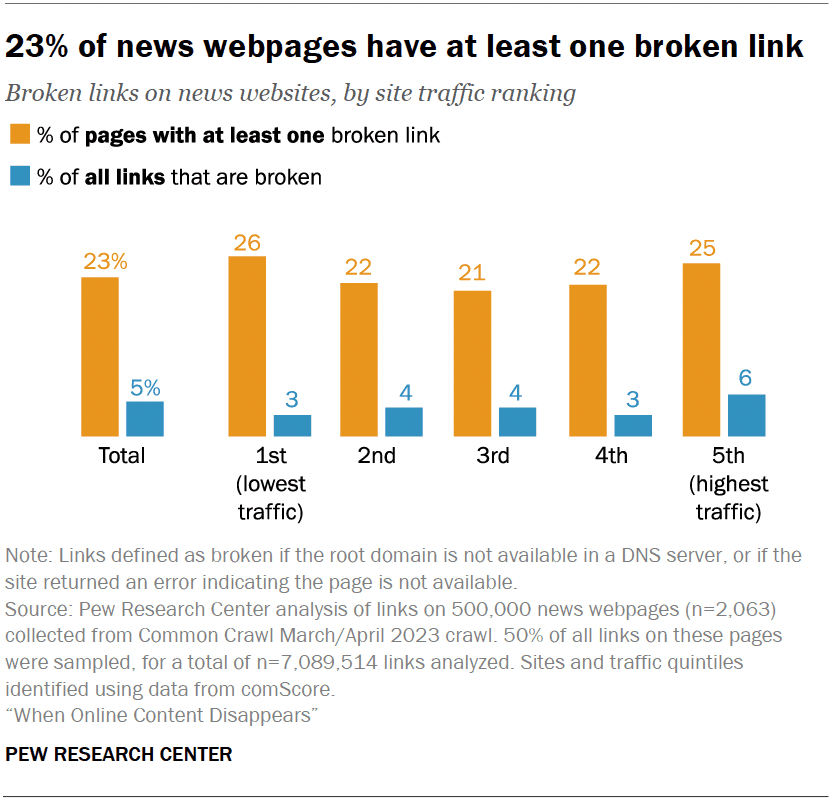
Our 2026 link rot research summary covers the broader decay data and preservation options.
What Current GEO Research Actually Supports
The strongest recent evidence favors relevance and useful information over cosmetic AI formatting.
A controlled 2026 study ran 252,000 paired citation trials across six language models. Topical relevance and the presence of query-relevant terms were dominant factors. Concrete information such as price, specifications, comparisons, evidence, and recent timestamps also helped in the tested product-review setting. Formatting a dense page into sections had a much smaller and inconsistent effect.
This experiment used a controlled two-document RAG setup, not the live retrieval systems of ChatGPT, Google, or Perplexity. It shows what models preferred after content was supplied to them. It does not prove that the same edit will make a page enter a commercial search engine's candidate set.
That limitation leads to a sensible order of operations:
- Make the page accessible and indexable.
- Make it the best semantic match for a real question.
- Include the concrete facts needed to answer that question.
- Support important claims with primary evidence.
- Keep the page, its internal links, and its cited URLs working.
- Measure repeated outcomes rather than treating one AI answer as a ranking report.
GEO Tactics You Do Not Need
Google published a dedicated guide to optimizing for generative AI features in 2026. Its mythbusting section rejects several widely repeated requirements:
- You do not need
llms.txtfor Google Search. Google says it does not use the file for Search or its generative features. Maintaining one for another service neither helps nor harms Google visibility. - You do not need special AI schema. Existing structured data should accurately match the visible page, but there is no generative-search-only schema requirement.
- You do not need to split every page into tiny chunks. Page length and section size should fit the reader and subject.
- You do not need to rewrite ordinary language for an AI. Google's systems understand synonyms and semantic meaning.
- You should not manufacture mentions. Inauthentic promotion remains spam, not authority.
Clear headings, tables, and concise answers can still improve usability. The correction is that they are content design choices, not guaranteed AI citation switches.
A Practical Link and AI Visibility Audit
Use this order so that you fix observable failures before speculative ones.
Step 1: Test the final URL
Confirm that every important page returns HTTP 200 without a challenge page. Test from outside your logged-in browser and inspect the raw HTML, not only the rendered interface.
curl -L -sS -D - https://example.com/important-page | sed -n '1,80p'
curl -L -sS -D - -A "OAI-SearchBot" https://example.com/important-page | sed -n '1,80p'
curl -L -sS -D - -A "PerplexityBot" https://example.com/important-page | sed -n '1,80p'
curl -L -sS -D - -A "Claude-SearchBot" https://example.com/important-page | sed -n '1,80p'
These user-agent probes can reveal simple blocking rules, but they cannot reproduce an official crawler's IP identity. Check server and CDN logs for the authoritative answer.
Step 2: Check robots and page-level controls
Review robots.txt, noindex, canonical URLs, nosnippet, and CDN bot policies together. A permissive robots file does not help if the WAF returns 403, and a noindex tag cannot be read if the crawler is blocked before it reaches the page.
Step 3: Repair internal discovery paths
Scan important hub pages, navigation, category pages, and the article itself. Fix internal links that return 4xx, skip unnecessary redirect hops, and make sure the canonical destination is linked directly.
For a single page, the Broken Link Checker Chrome extension provides a fast color-coded scan. Its Whole site view can manually crawl discovered pages on the same host and show every source page for a failed destination. Use a scheduled crawler when you need automatic monitoring, and follow our seven-method broken link audit for complementary checks.
Step 4: Verify outbound evidence
Open every source used for an important claim. Replace dead secondary summaries with live primary research where possible. If a valuable source disappeared, look for an official replacement or a preserved copy in a reputable web archive.
Step 5: Measure real visibility
Google's new Generative AI performance report is rolling out to a subset of Search Console properties. It reports impressions from AI Overviews and AI Mode by page, country, date, and device.
For other platforms, combine:
- referral traffic, including OpenAI's
utm_source=chatgpt.comparameter - server logs for verified crawler visits
- repeated prompt tests across several phrasings and dates
- citation tracking for a defined set of commercially relevant questions
AI answers are variable. A single uncited response is not enough evidence to rewrite a page, and one successful citation is not a permanent ranking.
The Click Reality
The reason citations matter is that generated answers can reduce visits to traditional listings. Ahrefs compared 300,000 keywords and found that the presence of an AI Overview correlated with a 58% lower average click-through rate for the top-ranking page in December 2025.
The underlying figures were:
| Keyword group | Position-one CTR, Dec 2023 | Position-one CTR, Dec 2025 |
|---|---|---|
| Informational keywords without an AI Overview in 2025 | 7.6% | 3.9% |
| Keywords that triggered an AI Overview in 2025 | 7.3% | 1.6% |
The study was observational, so "correlated with" is the accurate language. It still illustrates the commercial risk: ranking alone does not guarantee the click when a generated answer occupies the top of the result page.
A working citation is therefore valuable for two reasons. It creates an additional path to your site, and it lets the user verify that your page actually supports the answer. If that path ends in a 404, both benefits disappear.
FAQ
Do broken outbound links directly reduce AI search rankings?
No direct penalty has been publicly demonstrated. Broken outbound links reduce verifiability and create a poor user experience, and they may indicate that the underlying claim needs review. Treat a direct AI ranking effect as an unproven hypothesis, not a confirmed signal.
Which crawler should I allow for ChatGPT Search?
OpenAI identifies OAI-SearchBot as the crawler used to surface websites in ChatGPT Search. GPTBot is a separate control for potential model training. A publisher can allow OAI-SearchBot while blocking GPTBot.
Does blocking Google-Extended remove a site from AI Overviews?
No. Google says Google-Extended does not affect inclusion or ranking in Google Search. Googlebot access and normal Search eligibility control whether a page can appear as a supporting link in AI Overviews and AI Mode.
Does llms.txt improve GEO?
Google explicitly says it does not use llms.txt for Search or generative Search features. Other tools may read the format, particularly developer-oriented agents, but there is no general evidence that publishing the file increases cross-platform citations.
Can fixing broken links guarantee an AI citation?
No. Fixing links removes crawl, navigation, and click failures. Citation selection also depends on retrieval, relevance, competing sources, freshness, and the engine's own variable behavior.
How often should important sources be checked?
For frequently visited or revenue-critical content, check internal and outbound links at least monthly and after every migration, redesign, CMS change, or large content update. Lower-priority archives can use a quarterly schedule. See our guide to automatic broken link monitoring for implementation options.
Broken links are not a magic GEO ranking factor. They are something more concrete: failures in the infrastructure that lets content be discovered, verified, cited, and visited. Keep important URLs accessible, repair internal discovery paths, maintain the evidence behind your claims, and measure actual search visibility instead of chasing unsupported AI hacks.
Start with the page you care about most. Open it, run the Broken Link Checker extension, and fix every dead destination you control.

Pavel Molyanov
Creator of Broken Link Checker
Content marketer with 10+ years of experience. Founder of a content marketing agency. Writing about SEO, content workflows, and website maintenance.
Check Your Links in One Click
Broken Link Checker finds broken links and redirects on any page or across your whole website, and works in Google Docs and Sheets. Try 3 checks free, with no signup or card required.