Google's March 2026 Core Update: What Changed for Broken Links and Site Quality
The March 2026 Core Update was the most volatile core update Google has rolled out in years. The SEMrush Sensor peaked at 9.5/10 — a level reached only a handful of times since the tool started tracking ranking volatility. SE Ranking measured nearly 80% of top-3 results shifting during the rollout, and almost one in four pages that started in the top 10 fell out of the top 100 entirely.
If you maintain a site and you're still trying to figure out what changed, you're not alone. Google's only public description of the update was that it was "a regular update designed to better surface relevant, satisfying content for searchers from all types of sites." There was no Search Central blog post, no detailed walkthrough, no list of best practices. The update started on March 27 and finished on April 8 with little more than a tweet to mark its completion.
This article is not another rehash of whether broken links affect SEO — that ground is already covered, and Google's position on 404s as a direct ranking signal has not changed. The point of this piece is narrower and more specific: the March 2026 update raised the quality bar in ways that compound the indirect harms broken links cause. The categories of sites that were rewarded — primary sources, deeply-covered niche publishers, brands with original data — are exactly the categories that cannot afford to look unmaintained. The categories that lost — aggregators, directories, sites with shallow coverage — are the ones whose value collapsed when link quality started outweighing link quantity. Broken links sit right at that intersection.
What Happened: The March 2026 Core Update Timeline
Google announced the rollout on X and on the Search Status Dashboard on March 27, 2026. The update finished on April 8, 2026 at 9:12 AM Eastern Time. Total duration: 12 days, 4 hours — a relatively normal window for a core update, but the volatility packed into it was anything but normal.
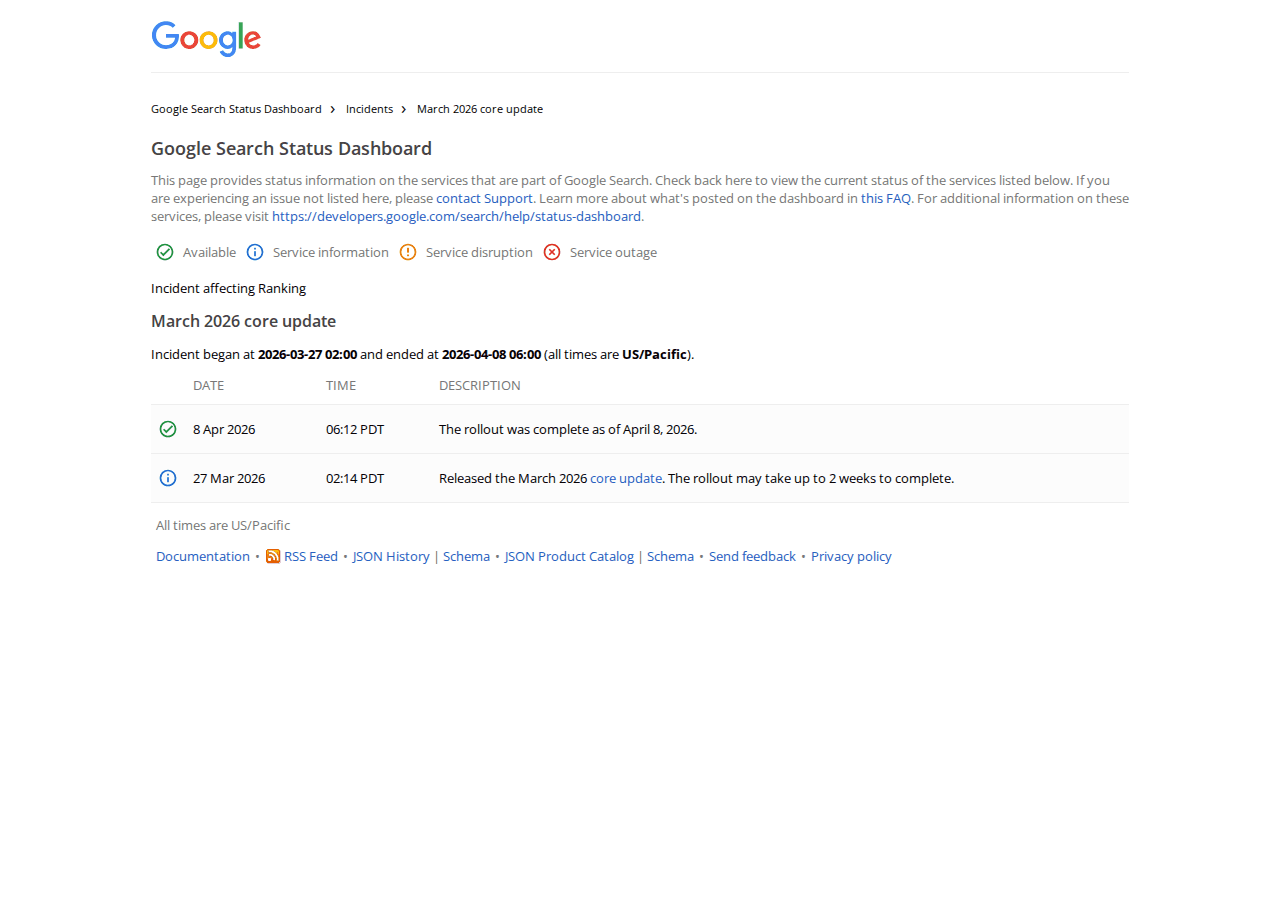
The numbers from the major SEO data providers tell a consistent story. The SEMrush Sensor, which tracks daily SERP volatility on a 0-10 scale, peaked at 9.5 — among the highest readings on record. SE Ranking's tracked SERPs showed almost 80% of top-3 results changing during the rollout, and nearly one in four top-10 results dropping out of the top 100, with more than 55% of monitored sites seeing noticeable ranking shifts in the first two weeks. Search Engine Land's coverage of the rollout aggregates the same pattern from Ahrefs' tracked dataset, where roughly 55% of monitored domains had at least one keyword cluster move by more than five positions.
Compared to the December 2025 core update, which had moderate volatility and a relatively predictable winners-and-losers pattern, March 2026 was sharper, broader, and harder to read. Search Engine Roundtable's confirmation post called it the most disruptive core update since the September 2023 Helpful Content Update.
The update did not target a single vertical or content format. It rewarded and penalized across categories — Google was emphatic in its description that the update was meant to surface "relevant, satisfying content" from "all types of sites," not a single format or industry. But the pattern of what got rewarded versus what got penalized is where the real story lives.
Winners and Losers: The Pattern Behind the Shift
Multiple analyses converged on the same picture. SISTRIX visibility data, SE Ranking's tracked SERPs, and Amsive's case-study breakdown of affected client sites all describe the same kinds of sites moving in the same directions.
| Winners | Losers |
|---|---|
| Primary sources and recognized brands | Aggregators and directories |
| Official institutions (.gov, .edu, professional bodies) | Comparison sites and review aggregators |
| Specialist/niche publishers with deep topical coverage | Online travel agencies (OTAs) |
| Sites with original data, original tests, original numbers | Job boards |
| Sites publishing comprehensively within a single subject | Broad sites with shallow coverage across many subjects |
| Pages with original data + expert commentary | Mass-produced AI content |
The most striking single datapoint came from SISTRIX visibility tracking, summarized in Amsive's winners-and-losers analysis of the update: YouTube experienced a drop of -567 visibility points in less than two weeks — the largest single-domain decline in Amsive's dataset, and roughly 30% larger than Wikipedia's drop during the December core update. Whatever Google adjusted, it was not afraid to move large publishers.
Industry analyses of affected sites converged on the same pattern: sites publishing original data tended to gain visibility (a 15–25% lift was a common observation across primary-source publishers), while sites whose content was mass-produced, templated, or AI-synthesized often saw 30–50% traffic declines, with the worst-affected losing up to 70%+ of their traffic in the weeks following the rollout.
Aggregators and directories were the cleanest example of the losing category. The value proposition of an aggregator is that it pulls together links and listings from across the web — its content is, by definition, not original. After March 2026, that value proposition collapsed at scale. Comparison sites in personal finance, travel, jobs, and product reviews saw broad declines. Sites that ranked because they covered many topics lightly were displaced by sites that covered fewer topics deeply. The same pattern played out in OTAs: when the underlying inventory is the same as ten other sites' inventory, Google now seems to prefer the source — the airline, the hotel chain, the official tourism board — over the middleman.
The Big Shift: Information Gain Becomes the Dominant Signal
The mechanism behind the winners-and-losers pattern is not new. It has been sitting in Google's patent filings since 2018. What changed in March 2026 is the weight Google now assigns to it.
The patent in question is US20200349181A1, "Contextual Estimation of Link Information Gain", filed in October 2018, published in November 2020, and granted in June 2024. The patent describes a system for scoring documents based on how much new information they contribute relative to what a user has already seen on the topic. A page that exhaustively covers a topic but contributes no new information receives a low information-gain score. A page that adds a fresh angle, original data, or a perspective the user hasn't encountered before scores higher.
For years, this was treated as a theoretical signal — interesting on paper, but not clearly load-bearing in practice. The March 2026 update is the first core update where the signal appears to carry substantial weight at scale across English-language queries. The fingerprint of an information-gain-driven update is exactly what the data showed: long-form, thorough pages that simply restate what the top 10 already says lost ground. Pages with genuine novelty — original screenshots, original measurements, expert commentary, primary research — gained ground.
The practical consequence is harsh for a particular kind of SEO content that has worked well for the last decade: the comprehensive guide that covers everything but adds nothing. If your "Ultimate Guide to X" is a careful synthesis of what the existing top-10 articles say, structured better and written cleaner, that strategy no longer wins. The synthesis itself is no longer the differentiator. What matters now is what only you can contribute — the data you collected, the test you ran, the customer interview you conducted, the screenshot from your own product, the number you measured rather than cited.
A second pattern showed up alongside Information Gain: domain-level authority outweighed page-level optimization more than in previous core updates. Sites with deep, sustained coverage in a single subject area beat sites with broad shallow coverage even when the broad sites had better on-page optimization on the specific query. The signal Google is reading appears to be something like "is this site recognized as a source on this subject" rather than "is this page well-optimized for this query." The two used to correlate; in March 2026 they decoupled, and the domain-level signal won the tie-breaker more often than not.
Where Broken Links Fit in the New Quality Bar
This is the section where care matters most, because it's easy to overstate the connection. Broken links are not a direct ranking signal. John Mueller said so in 2025, and the March 2026 update did not change that. If you read SEO content claiming that the update "started penalizing sites with broken links," that claim is not supported by anything Google has said or by any analysis of the SERP movement.
What did change is the weight of the signals that broken links indirectly affect. Five mechanisms matter, and all five got more important in March 2026.
Aggregators lost — link quality now outweighs link quantity. The clearest losers in the update were sites whose value depended on having lots of outbound links. When Google reweights that category downward, the implicit message is that link quantity by itself no longer carries the value it used to. Link quality is what's left, and a broken outbound link is a low-quality reference by definition. A page with 30 outbound links, three of which are dead, is sending a worse signal than a page with 20 outbound links that all work — both for users and for whatever signals Google is reading from the link graph.
Primary sources won — and primary sources are expected to be maintained. If you're trying to be the kind of site the update rewarded, you're trying to be a primary source. Primary sources are held to a higher maintenance standard than aggregators by definition. A government site with broken links to its own historical records, or a research publication with broken citation links, or a brand publisher with broken outbound references to its own data — all of these contradict the primary-source positioning. The signals propagate: a site that asks to be treated as a source needs to look like one.
Domain-level authority took on more weight — and neglect signals propagate. Because the update shifted weight from page-level optimization to domain-level authority, individual page problems matter less in isolation and more in aggregate. A site with hundreds of broken internal links is sending a domain-wide neglect signal. The exact threshold isn't published, but our analysis of the practical thresholds is in how many broken links is too many — the rough industry datapoint is that sites passing 2% broken-link ratios start showing measurable SEO effects, and 5% becomes severe. Under the new domain-weighted model, those thresholds matter more, not less.
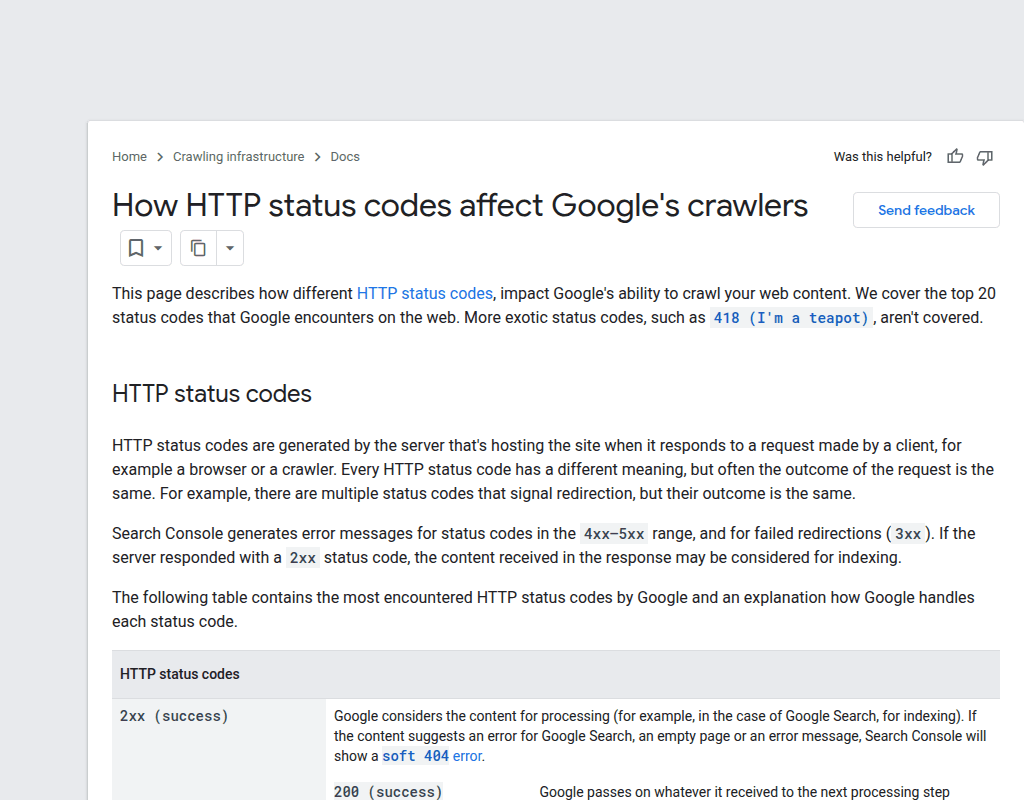
Crawl efficiency matters more when sites are judged holistically. Google's crawl budget documentation is explicit that broken links waste crawl budget. The documentation hasn't changed, but the way Google weights holistic quality has. When the algorithm is reading domain-level signals more heavily, the proxy signals for "is this site well-maintained" get more attention. Wasted crawl on dead URLs is one of those proxies. So are soft 404 errors, which compound the same problem in a more subtle way: pages that return 200 OK while looking like errors confuse Googlebot and waste the same crawl resources broken links do.
Trust and freshness — a broken link is content rot in plain sight. A page from 2022 with 15 outbound references, eight of which now 404, is visibly stale. The information-gain framing of the update reinforces this: a page that was original two years ago but now references nine dead sources isn't a primary reference anymore. It's an artifact. The same applies to outbound references rotting on their own — see how to prevent link rot for the specific decay rates and prevention techniques. When the algorithm rewards freshness and original authority more aggressively, the indirect cost of letting outbound references rot rises.
None of these mechanisms make broken links a direct ranking factor. They make broken links a contributor to the cluster of signals that the March 2026 update weighted more heavily than its predecessors. The mechanism is the same as it was a year ago. The cost has gone up.
What Google Officially Recommends After Core Updates
Google's standard guidance for core updates hasn't changed in years, and the company didn't issue update-specific guidance for March 2026. The advice on the Core Updates documentation page is the guidance Google wants site owners to follow.
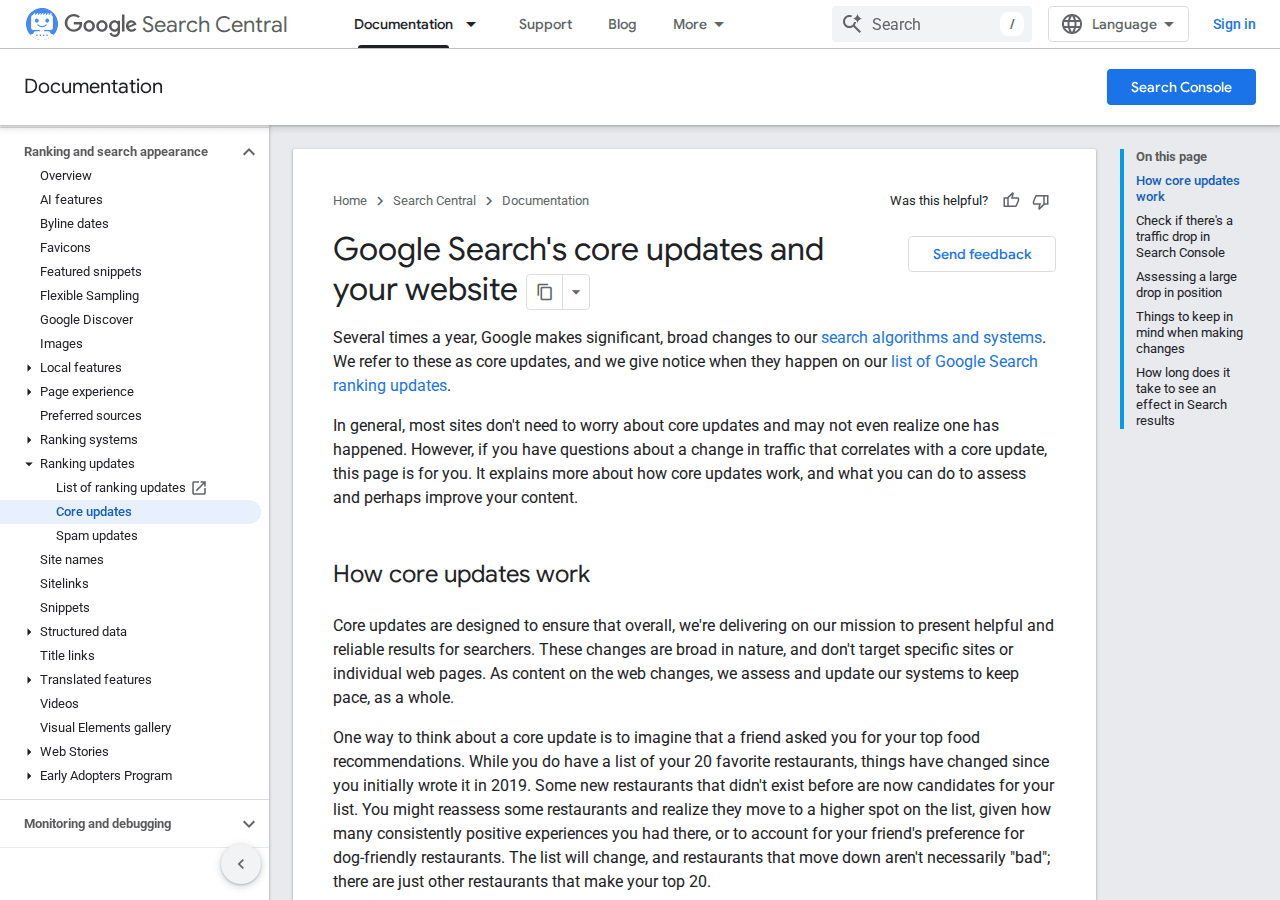
The page repeats the same core message after every update: there is no quick fix, the changes are not punishments for specific issues, and the path to recovery is producing helpful content over time. Google links to its Helpful Content guidance as the canonical reference. The Helpful Content document asks site owners to evaluate their content against questions like "Does the content provide original information, reporting, research, or analysis?", "Does the content provide substantial value when compared to other pages in search results?", and "Does the content provide insightful analysis or interesting information that is beyond the obvious?"
The framing of those questions tracks closely with the Information Gain pattern in the March 2026 results. Original information. Substantial value compared to other pages. Beyond the obvious. The questions Google has been asking site owners to answer for years are the same questions the update apparently weighted more heavily. The update didn't introduce a new standard. It enforced the existing one harder.
Google's advice for sites that lost rankings during a core update has also been consistent: don't make panicked changes, don't try to game the next update, focus on the content questions in the Helpful Content guidance, and recognize that recovery typically waits for the next core update. The next confirmed core update window will be Google's signal, not yours.
What Google does not say — and what site owners often miss — is that the technical foundation underneath the content matters too. A site can produce original, helpful content and still lose rankings if the content is buried under broken navigation, slow-loading pages, soft 404s, and dead outbound references. The content questions are necessary; the technical hygiene is the ground they stand on.
Recovery Playbook: Audit and Fix in the Right Order
If your site lost ground in the March 2026 update, the recovery playbook isn't different from sound technical SEO and content practice. What's different is the order of priority and the standard the work has to meet. Here is what the data and the patterns suggest.
Audit before claiming primary-source status. The update favored sites that look like primary sources. Before you start adding "according to our data" or "based on our testing" to articles, audit what you already have. Run the audit described in our guide on finding broken links. A site that publishes original research while pointing to dead citations is sending a contradictory signal, and the algorithm reads contradictions as low quality.
Eliminate internal broken links first. Internal broken links are entirely under your control. They waste your own link equity, disrupt the site architecture Google uses to evaluate domain-level authority, and concentrate domain-level neglect signals where they count most. External broken links matter, but they decay continuously through no fault of your own. Internal broken links are evidence of your own neglect. Fix them first.
Prioritize the highest-traffic pages. Domain-level authority takes weight from individual pages, but not equally. The pages that contribute most to your domain authority are the pages that already have the most traffic and the most inbound links. A broken link on the homepage costs more than a broken link on a deep archive page. Use Google Search Console's Pages report and analytics to pull your top-traffic URLs and audit them first.
Add original data wherever you can. This is the highest-impact change you can make in response to the update. Original screenshots, original tests, original numbers, original customer quotes, original product data — anything that meets the Information Gain threshold. The time investment is real, but the trajectory of Google's algorithm is moving away from rewarding good synthesis. The exit is upward, into actually generating new information.
Fix soft 404s and irrelevant redirects. Google now treats redirects to unrelated destinations — the homepage, a generic category page — as soft 404s for the original URL. The shortcut of "redirect everything to the homepage" stopped being safe years ago, and the new domain-weighted algorithm makes it more costly. The full handling guide is in our soft 404 errors article. Pair this with a full audit before any redesign — the worst soft 404 outbreaks happen when URL structures change without comprehensive redirect mapping.
Set up ongoing monitoring. A one-time audit gets you to a clean baseline. Keeping a clean baseline is a different problem. Links rot continuously: external sites change their URL structures, internal pages get reorganized, CMS updates break URL patterns, redirects chain into longer chains and eventually break. The only realistic answer is automation. Our automatic broken link monitoring guide walks through the options, from Search Console alerts to scheduled crawler runs to the Broken Link Checker plugin for WordPress.
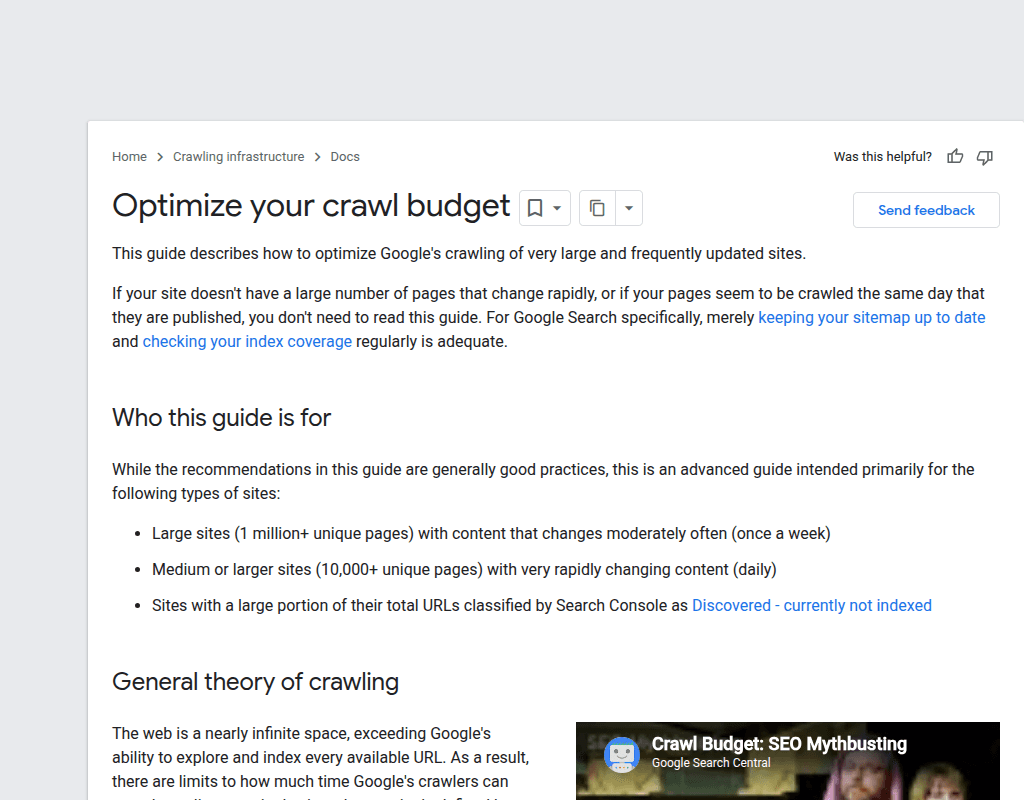
For larger sites, the crawl budget angle becomes a hard cost. Google's documentation states explicitly that pages identified as soft 404s "will continue to be crawled, and waste your budget." The same applies to broken internal links — Googlebot follows them, gets a 404, and that crawl request is gone. On a 50-page site, crawl budget isn't a constraint. On a 50,000-page site with thousands of broken internal links, the crawl budget waste is real and the new domain-weighted quality signals make it visible.
The recovery timeline is uncomfortable. Google has stated repeatedly that core update recoveries typically wait for the next core update. There's no quick fix, no expedited review. What you can do is make sure that when the next core update rolls out, the signals on your site point in the right direction: a maintained primary source with original content, working links, clean crawl paths, and a clear focus on the topics where your domain has earned the right to rank.
What This Means Going Forward
The trajectory is consistent across the last several core updates. Google is moving toward a model where domain-level signals — what the site is, what it covers, who maintains it, whether it produces original information — outweigh page-level optimization. The Information Gain patent has been sitting in the algorithm's potential weight set since 2018. March 2026 appears to be the inflection point where it became dominant. There is no reason to expect that direction to reverse.
Google's broader Preferred Sources work — letting users mark sites they want to see more of, with the system using those signals to nudge results in their favor — has been rolling out in stages, and the brand-as-signal pattern visible in March 2026 fits the same direction of travel. The same logic shows up in the May 2026 update to Google AI Mode and AI Overviews, which formalized brand-trusted citations and subscription-linked sources inside AI answers. Recognizable, well-maintained brands are getting more weight in both surfaces.
For site owners, the implications are straightforward in direction and demanding in execution. The bar for "what makes a site rank" is rising. Producing helpful content remains necessary. Producing original content is increasingly necessary. Maintaining the technical foundation underneath the content — working links, clean crawl paths, no soft 404s, no dead references in published material — is the cost of staying in the conversation. The pace of decay is itself measurable: see the 2026 link rot research for the underlying numbers on how quickly outbound references die. None of these alone are ranking signals. Together, they are the texture of a site that looks like the kind of source the algorithm is now choosing to reward.
The cost of neglect compounds. A handful of broken links on a well-maintained site doesn't matter, and that hasn't changed. A pattern of broken links across a site that's also losing ground on content originality is a different story — and the March 2026 update made the consequences of that combination more visible.
FAQ
Did the March 2026 core update target broken links specifically?
No. The update was a broad core update that adjusted the weights of multiple quality signals — particularly Information Gain and domain-level authority. Broken links are not a direct ranking signal, and that did not change. What changed is that several of the signals broken links indirectly affect — domain-level quality perception, crawl efficiency, primary-source positioning — got more weight in the new model. The result is that the indirect cost of broken links is higher now than it was before the update, even though Google did not introduce a "broken links penalty."
How long does it take to recover from a core update drop?
Google has been consistent for years: core update recoveries typically arrive with the next core update, not with intermediate algorithm refreshes. Practically, that means several months. The March 2026 update completed in early April; the next core update could arrive anywhere from a few weeks to several months later depending on Google's schedule. Use the time between core updates to fix the technical foundation, audit content for originality, and address the questions in Google's Helpful Content guidance. There is no reliable way to expedite recovery.
Does fixing broken links help recovery?
Fixing broken links is necessary but not sufficient. It addresses one of the indirect signals that the update weighted more heavily, but it does not address the dominant signal — Information Gain. A site that fixes every broken link but continues to publish thin synthesis content will still struggle in the new model. The recovery playbook is content originality first, technical hygiene close behind. Both matter; only one of them is enough on its own to move rankings.
What was the biggest change in this update?
Information Gain becoming a dominant signal at scale. The patent has existed since 2018, but March 2026 appears to be the first core update where the signal carried substantial weight across English-language queries. The downstream effect was that comprehensive guides without genuine novelty lost ground, while pages with original data, original testing, or expert commentary gained ground. Aggregators and directories were the cleanest losing category because their value proposition is incompatible with the Information Gain model.
How does this affect small sites vs large sites?
Small sites with deep coverage in a single niche tended to do well — the update rewarded specialist publishers, including small ones. Small sites with broad shallow coverage tended to do poorly, for the same reason large sites with broad shallow coverage did poorly. Crawl budget effects are more material for large sites, but the core content questions apply equally to small and large publishers. The most consequential factor wasn't site size — it was whether the site was perceived as a recognized source on its subject. A 30-page niche publisher with original data on its subject can outperform a 30,000-page generalist site under this model, and that's part of what the data showed.
For the routine work of keeping your site's links clean, the Broken Link Checker extension scans every link on a page in one click and flags broken ones in red. Use it on your highest-traffic URLs first — those are the pages where the new domain-weighted quality signals concentrate, and the pages where broken-link cleanup carries the most weight.

Pavel Molyanov
Creator of Broken Link Checker
Content marketer with 10+ years of experience. Founder of a content marketing agency. Writing about SEO, content workflows, and website maintenance.

Check Your Links in One Click
Broken Link Checker finds broken links and redirects on any page or across your whole website, and works in Google Docs and Sheets. Try 3 checks free, with no signup or card required.